PERSPECTIVES · LANGUAGE & AI
Speaking in Tongues
Why Africa’s AI future depends on its languages
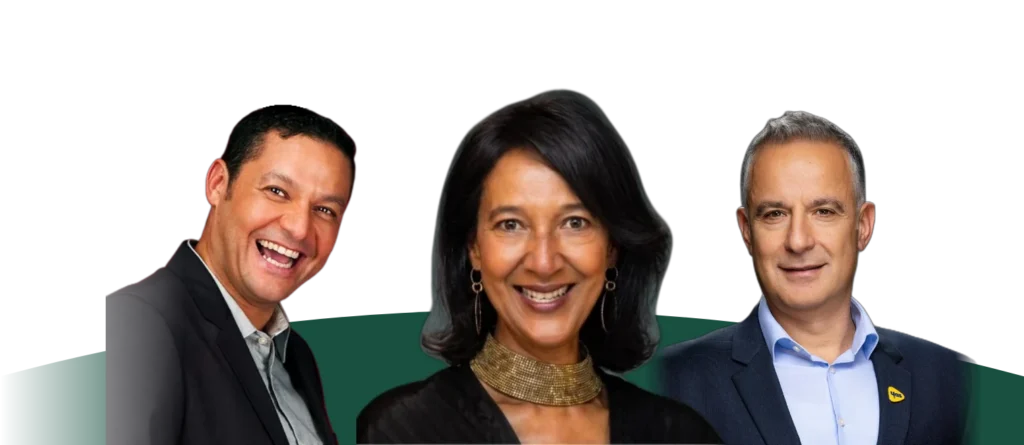
By Nikos Angelopoulos, GSMA Strategic Executive Advisor, in conversation with Enzo Scarcella (MTN Group), Bernice Samuels (Strategic Advisor, former MTN Group executive) and Hassan Jaber (Group CEO, Yas).
13 min read
ATLAS Umoja AI – In Africa, For Africa, By Africa
A few years ago, on a trade visit to rural Zambia, Enzo Scarcella met a woman who could have been his mother, a well-dressed, educated lady, carrying a feature phone. He asked why she’d never bought a smartphone. “I don’t really need Facebook,” she told him. To her, the internet was Facebook, and nothing on it had ever spoken to her life.
Bernice Samuels felt the same gap from the other side. She had moved to Mauritius, opened an app, and found it entirely in French. “I don’t speak French,” she says, “even though French is a ‘high-resource’ language. Here I was, supposedly highly literate, used to apps and smartphones – and I was completely lost.”
Two stories, two ends of the same problem:
“Access without relevance isn’t really access at all.
That gap is what the GSMA-backed ATLAS Umoja AI exists to close: a pan-African, open program working, country by country, to bring as many of Africa’s 2,000-plus languages into AI as it can, openly releasing the resulting models for anyone to build on. Enzo Scarcella and Bernice Samuels, both of MTN Group, and Hassan Jaber, CEO of Yas Group, sat down separately with GSMA’s Nikos Angelopoulos to talk about what’s at stake. What follows draws on those conversations as well as insight from GSMA Intelligence’s findings from 2026 Mobile Economy Report.
What gets lost in translation
Ask any of the three why this matters, and they arrive at the same answer by different roads.
For Scarcella, it starts with how people think. “People don’t communicate in a language,” he says. “They think in a language, they conceptualise in a language, and they feel in a language.” One of the fundamental building blocks of humanity and culture, he argues, is language itself – and Africans have spent decades communicating through someone else’s.
For Samuels, the same insight arrives through marketing rather than technology. “Language is not a nice to have,” she says. “It’s the fundamental foundation of belonging.” She has seen it in her own career: campaigns and brands only work when people feel seen — “not as a segment, but as someone whose language, memory and aspiration are already in the room.”
Jaber, whose career spans three decades across Africa and who now leads Yas Group’s operations in eleven countries, puts it more directly. Speak to someone in a foreign language, he says, and “even if you perfect it, you are still not speaking to the heart and mind and souls of the people” – because something is always lost in translation: “the cultural, the emotional part that lets you understand each other.”
None of the three separate culture from language when they talk about inclusion – it’s the same conversation, and the premise the rest of this piece builds on. Language is not a feature to add once the hard technical work is done. It is the foundation.

People don’t communicate in a language. They think in a language, they conceptualise in a language, and they feel in a language.
Enzo Scarcella
Group Executive: Consumer, MTN Group

Two thousand languages, one design choice
The scale of the problem is easier to picture with numbers. Scarcella cites MTN’s own figures: around 310 million subscribers, with 4G networks reaching 92 to 93% of them, yet only about half actually online. The other half are not held back by coverage. They are held back by relevance.
Samuels frames the same problem differently. The industry talks about “high-resource” and “low-resource” languages, she says, and Africa is designated low-resource largely because its languages come from oral tradition, with little written data to train systems on. That, she points out, is a design choice, not a fact of nature. “Two thousand languages isn’t a problem to solve,” she says. “It’s dignity for the customer and scale for the business – if we stop treating oral languages as data-poor and start treating them as markets we never built for.”
The pattern holds at continent scale. GSMA Intelligence puts Africa’s “usage gap” – people covered by mobile broadband but still offline – at 63% of the population, against 9% with no coverage at all. The bottleneck has shifted from building networks to giving people a reason to use them.
The gap is relevance, not coverage.
63%
of people in Africa are covered by mobile broadband but still offline: the usage gap
9%
have no mobile broadband coverage at all
~50%
of MTN’s ~310m subscribers are online, although 4G reaches 92-93% of them
2,000+
languages spoken across Africa, most of them barely understood by AI
Sources: GSMA Intelligence, The Mobile Economy Africa 2026, MTN Group figures
From apps to conversation
All three guests, independently, pointed to the same underlying shift: the interface itself is changing, from apps to voice.
For Samuels, that shift is already underway. “In the past, offering a service in someone’s mother tongue was a feature,” she says. “Today, and with voice agents going forward, it’s not a feature – it’s the new user interface. It’s the norm.” An app, she argues, still asks people to come to the institution, in its structure and its language. A voice agent in the mother tongue meets them in theirs. “That is not localisation. That is a different relationship.”
Scarcella frames it as a matter of when, not if: “I don’t know exactly when local language models get built into a smartphone’s voice interface at scale,” he says, “but I can tell you there’s probably a billion people on the African continent waiting for that to happen.”
Jaber’s view is more conditional, and consistent with his broader theme: the appetite is there, but capital decides the pace. Asked whether AI agents in local languages could help people leapfrog the app economy altogether, he agrees they could – “it will do” – but only once the affordability barrier he raises elsewhere in this piece is solved.
There is already a live signal for what that shift looks like: financial services accessed entirely by voice, in the user’s own language, is gaining enthusiastic adoption in parts of Southeast Asia. Boost Bank launched the Boba Voice service, an agentic AI based assistants that handle 90% of inquiries with over 80% resolved in the first interaction. Additionally, RYT Bank in Malaysia also launched their RYT AI based intelligent banking assistant signalling another marker in the move to user interfaces that simplify and increase usage.
Africa’s own leapfrogging record – mobile money over banking, mobile phones over landlines – suggests the same pattern could repeat here, once the investment case Jaber describes is met.
A voice agent in the mother tongue meets them in theirs. That is not localisation. That is a different relationship.
Bernice Samuels
Strategic Advisor; former Group Executive, Brand and Marketing, MTN Group

The business case investors respond to
None of the three treat this as charity. Scarcella points to MTN’s own framework for closing the digital divide – coverage, handsets, pricing, services and education (CHASE) – arguing that once language stops being a barrier, “everything he needs as a farmer is right in front of him.”
Jaber makes the market case even more directly. Understand people in their own language, he says, “and you’ll know what 200 million people really need – and that will help you innovate better, develop better products, and connect more people.”
The numbers back the wager. Mobile technologies supports 13 million jobs and generated $240 billion in economic value across Africa in 2025 – 7.8% of regional GDP – projected by GSMA Intelligence to reach $290 billion by 2030, backed by $76 billion in projected network investment over the same period.
The business case
$240bn
economic value generated by mobile technologies across Africa in 2025
7.8%
of regional GDP
13m
jobs supported by mobile technologies
$290bn
projected value by 2030, backed by $76bn in network investment
Sources: GSMA Intelligence, The Mobile Economy Africa 2026
In Africa, for Africa, by Africa
The clearest thread running through all three conversations is the initiative’s own tagline. It is not marketing language added afterwards – every guest engages with it directly, unprompted.
Scarcella is unambiguous about the alternative. “What will happen here is what has happened in every previous generation of technology,” he says. “We’ll become consumers of it. And in Africa, for Africa, by Africa, will be a tagline that sits on this board. It won’t be lived – unless we embrace it and own it, and put the power into our own people’s hands.”
For Samuels, the answer pairs urgency with self-definition. “We have to move with ownership. We have to move with urgency,” she says. “GSMA convening the G6 — and programmes like ATLAS Umoja — are allowing us to define our own model, rather than import solutions that weren’t built for us.”
Jaber, asked directly what he made of six mobile operators uniting behind that ambition, doesn’t hesitate. “That’s why it’s very important, and it actually translates the strategy I was talking about – allowing the private and public sectors to work together to find the capital to develop AI in Africa, because we don’t want Africa to be left behind,” he says. “We were happy that GSMA liked the initiative, and Yas took the lead to push it forward.”
That ambition is now a matter of record. In October 2025 at MWC Kigali, GSMA and the G6 African operators – Airtel, Ethio Telecom, MTN, Orange, Vodacom and Yas – formally announced this collaboration, built to tackle four structural barriers to African-led AI: models, data, compute, and talent.
Three operators, three professional lenses – marketing, technology, pan-African leadership – arriving at the same conviction, unprompted. That convergence is itself a kind of evidence: this is not one company’s idea. It is a shared read on where the industry must go next.
Who the work belongs to
Ownership, for all three, extends beyond who builds the technology to who the work belongs to once it exists. ATLAS Umoja AI’s own model is explicit on this point: it works country by country with local communities to collect language data, then trains and openly releases the resulting models and benchmarks for anyone to build on, rather than having that work done, and owned, elsewhere.
That instinct – that the work has to be rooted locally, not imported – runs through the interviews even where data or IP aren’t named directly. Samuels frames it as refusing to stay on the edge of someone else’s system: “Here’s an opportunity for us to build our own systems.” Jaber puts it more bluntly, telling governments and investors alike that the only way to prove a business case is to build one: “You need to dig your own oil out.”
Read alongside ATLAS Umoja AI’s own commitment to open, locally collected data, that is the fuller argument: not just who writes the code, but who the language data belongs to, and who decides how it is used – ownership at every layer, language, models and the data beneath them, even if none of the three phrase it in exactly those terms.
One concrete example of what that looks like: in February 2026, Google released WAXAL, an openly licensed speech dataset spanning 27 Sub-Saharan African languages, built with Makerere University, the University of Ghana and Addis Ababa University – training data for languages spoken by over 100 million people, released so African researchers could build on it directly.
Where it plays out: health, money, classroom and beyond
Move past the principle, and the argument gets concrete fast – most powerfully in healthcare.
Scarcella recounts a friend from medical school who spent a year learning isiXhosa after being posted to rural Transkei. Asked why, given he could have found workarounds, his friend said simply: “I cannot be a decent doctor, never mind a good one, if I cannot understand what’s wrong with my patients – and I cannot understand that if I don’t speak their language.”
Samuels reaches for a case from Johannesburg: someone who went through the health system, not an English speaker, given information at a hospital they did not understand, “down to the point where they were expected to phone a number to confirm an appointment.” They walked away with instructions on paper, in English. “They left with paper in a language that was not theirs, and a phone number they were expected to call,” she says. “We call that access. It is not. Access that cannot be understood is just another closed door – and in health, that door has consequences.”
Jaber’s version is more systemic: language-matched AI, he says, could connect a patient anywhere in Africa to a doctor anywhere in the world, each communicating in their own language, building the trust and statistics that let insurers extend cover too.
On money, the case is about who gets to build wealth at all. Outside South Africa, Scarcella notes, there are almost no credit bureaus in MTN’s markets, so most people can’t prove they are a good credit risk – something he believes language-literate AI, working from non-financial data, could help solve.
On education, Samuels makes the case through identity as much as outcomes. “When a child can learn in their mother tongue through AI-powered systems, comprehension goes up, retention goes up, and aspiration rises.” More than scores, she argues, the child begins to believe the future is addressed to them. “When a child learns in the language they dream in, they do not only understand more, they start to see themselves in the system.”
Jaber comes at the same theme from an employer’s side, noting that requiring English or French to get hired filters out “20, 30%” of genuinely capable people.
In farming, there are clear needs for using computer vision to provide diagnoses on crop health and provide a regionally relevant action plan in local language to small holders who are, by the very nature of what they do, remote. Translating complex legal tenancy documents into Yoruba, Hausa, Igbo and Pidgin, have proven invaluable in helping Nigerian’s navigate housing disputes and understanding legal rights. AI-based civic access tools are being developed that help citizens understand complex laws[CM1] into legally accurate and locally relevant languages ensure harmony between the populus and governments.
The possibilities are endless and provide value and opportunity for whole nations.
A narrower window than 4G
Jaber’s sharpest material in the whole series is about timing and money, and it does not appear in the other two interviews at all.
His comparison point is 4G. When that technology reached Africa, he argues, it rolled out slowly enough that the continent had time to prepare its own infrastructure and catch up. AI will not be so forgiving. “AI is evolving so fast, you have new agent AI every five minutes, and Africa is nowhere,” he says. “When AI is adopted by all the developed world and Africa is still behind, you will see a very big gap.”
He is equally candid about what is actually holding progress back: not ambition, but affordability. “So far I only see shy attempts,” he says. “Even if I build a GPU factory tomorrow, honestly, what percentage of people could afford to use it, whether you put it in Ghana… or you would put it in Nigeria? It’s very, very small.”
His answer is that capital must be African-led, deliberately, rather than waited on. “The private and public sectors need to work together to develop policies and roadmaps so the right capital gets put in place… the starting point is investment in the language itself. That’s the starting point. And then everything else will come along.” Yas’s own decision to back the initiative, he says, was not a hard sell internally: “Since day one, when we were proposed to be part of this project, we jumped on it – because we know it starts with the language.”
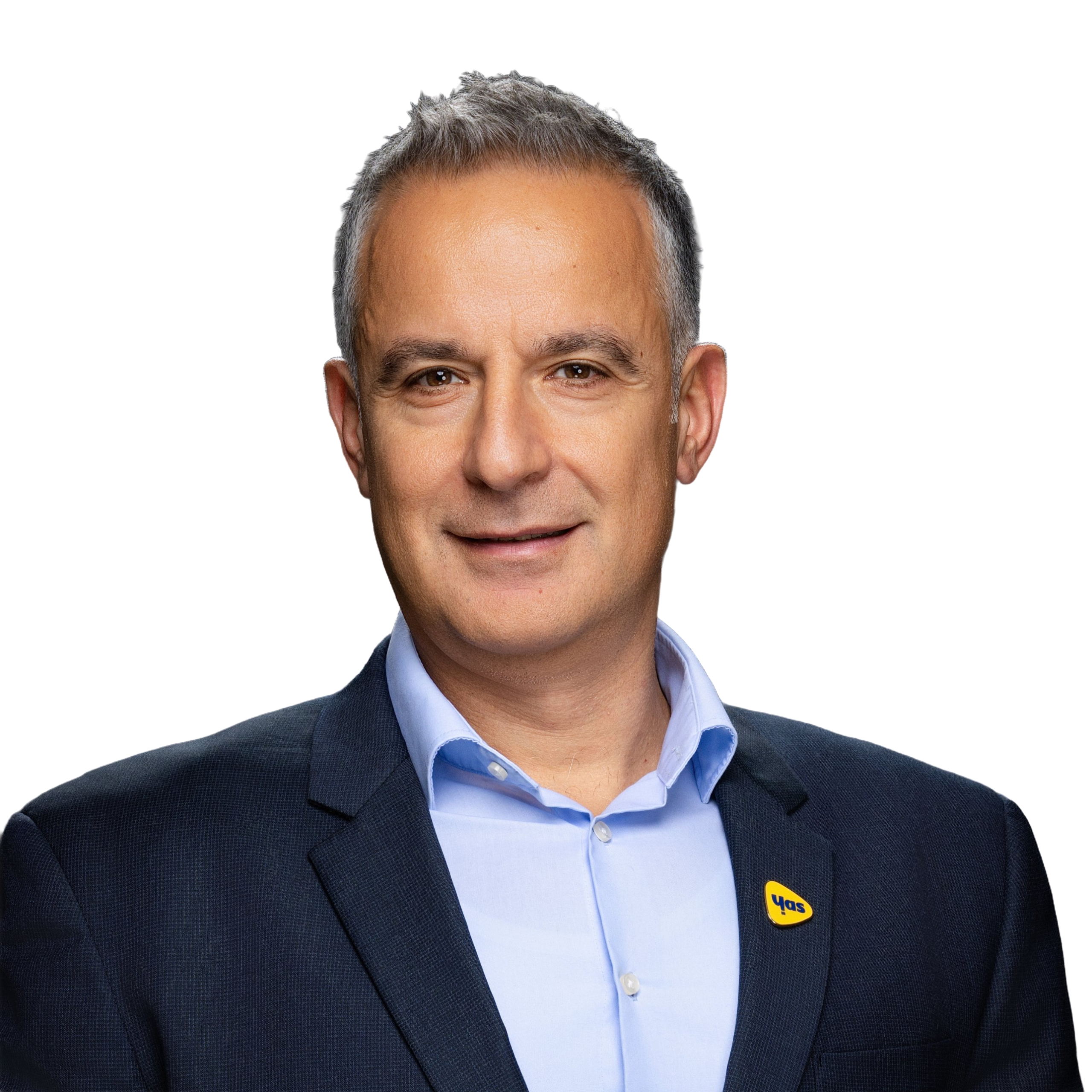
Since day one, when we were proposed to be part of this project, we jumped on it – because we know it starts with the language.
Hassan Jaber
Group CEO, Yas Group
A message to builders, and to governments
Samuels’ message to the next generation of African developers is short and direct: “Don’t just take what’s there and use it. Shape it – the data, the voice, the assumptions. Because if we only fine-tune someone else’s model, we will fine-tune someone else’s world. It’s in your hands to do so.”
That appetite is not hypothetical. A UNICEF-GSMA poll of more than 50,000 young Africans found three in four already use AI several times a week, and nearly a quarter said their needs are rarely considered in platform decisions 1. That generation is arriving regardless; the question is whether it arrives to tools that speak its language.
Jaber’s message to governments is the sharpest of the three. Too many, he argues, are waiting for someone else to move first. “No one will come as charity, especially in this new technology,” he says. “You need to have a business case, and the only way to prove you have one is to start something yourself.”.
Ten years from now
Ask each guest to picture ten years out, and the answers land in the same place from three different directions.
Scarcella pictures his own son, who was very small when they visited “a country in Europe – or it may have been America,” and who, after being quiet for a long while, said: “there are no beggars on the street.” For him, that is the measure of success – “a real achievement in Africa, where we are in charge of our own destiny…”
Samuels prefers a different word to “excluded”: “linguistically invisible” – and a different direction of travel. “The switch,” she says, “is from invisible to visible.”.
Jaber’s picture is the most literal of the three, and not only a rhetorical one: agriculture is projected to account for roughly a fifth of the additional economic value mobile technology adds across Africa by 2030, among the largest shares of any sector. He imagines an African farmer with the same access to financing and equipment as a farmer in the US or France, selling into local and international markets alike. “There will be no disparity between how he lives his life, how he produces, how he makes his money… between him and others in other parts of the world.” Africa, he says, is rich already – “but that potential isn’t being exploited or realised so far.”
[1] The Mobile Economy Africa 2026 Report – GSMA Intelligence, June 2026.
Three different professions, three separate interviews, three answers that describe the same destination: dignity, visibility, parity.

Dignity
“A real achievement in Africa, where we are in charge of our own destiny.”

Parity
“There will be no disparity between how he lives his life, how he produces, how he makes his money”
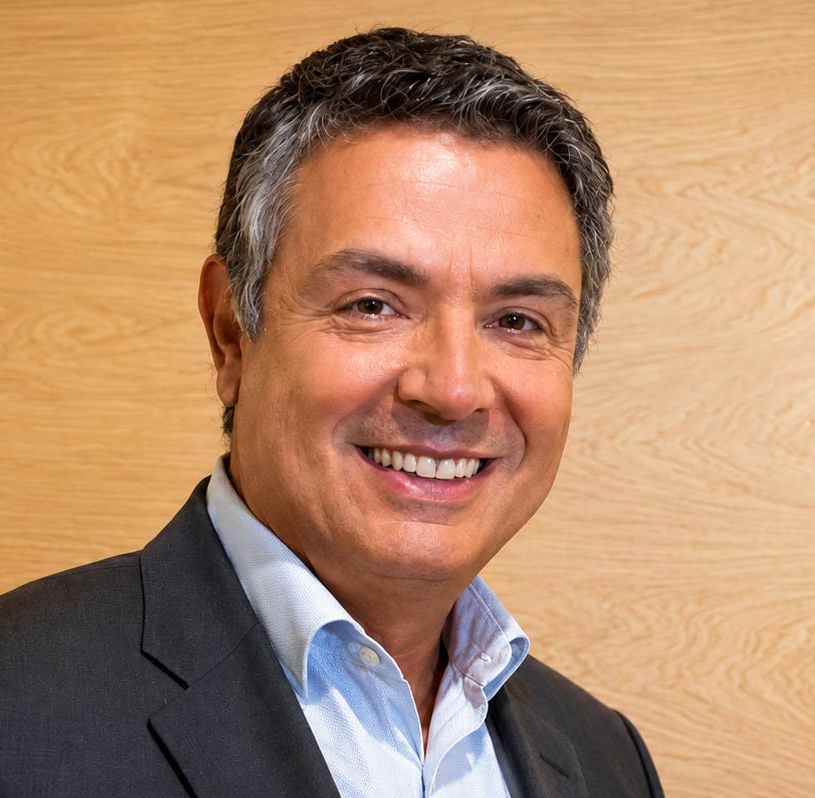
Former GSMA Strategic Advisor, Author and Interviewer
“Access without relevance isn’t really access at all.”
Nikos Angelopoulos, Former MTN Group Chief Information Officer
ABOUT ATLAS UMOJA AI
In Africa, for Africa, by Africa
ATLAS Umoja AI is a pan-African, open initiative, convened by GSMA and Awarri, uniting governments, researchers and developers to close the gap between Africa’s 2,000-plus languages and the AI that barely understands them. Country by country, it works with local communities to collect language data, then trains and openly releases benchmarks and models on Hugging Face, free for anyone to build on.